
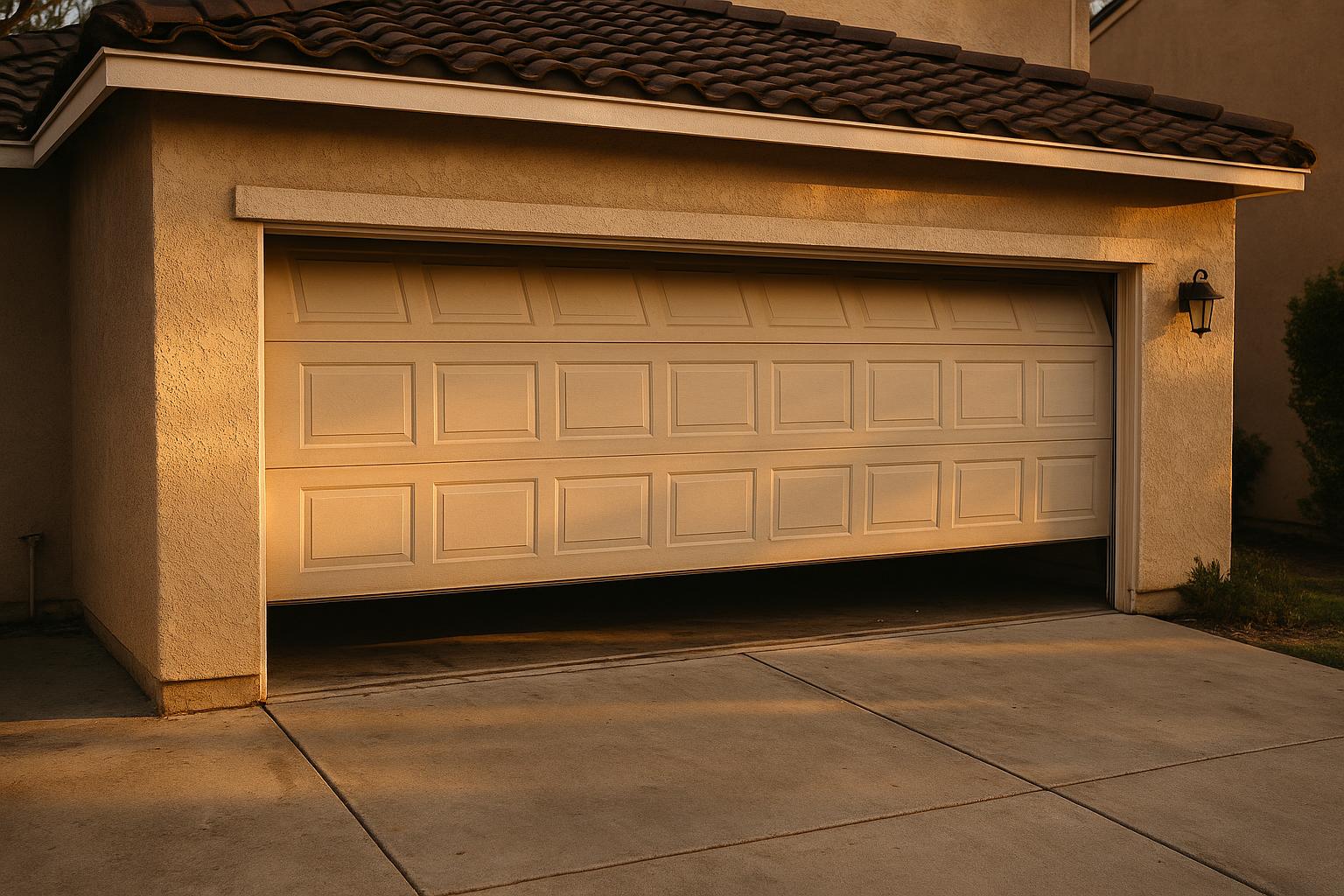
That Frustrating Moment When Your Garage Door Won't Stay Closed
You press the button on your remote, watch the garage door start its descent, and then — just before it touches the ground — it stops and reverses right back up. You try again. Same thing. Maybe you try holding the wall button. Still reverses.
This is one of the most common garage door problems we see here in Canyon Lake, and it's more than just an annoyance. A garage door that won't fully close is a security risk, an invitation for pests, and during our hot Inland Empire summers, it means your garage turns into an oven that heats up the rest of your home.
The good news? This problem almost always has a logical, fixable cause. Let's walk through the most common reasons your garage door reverses before hitting the floor and what you can do about each one.
1. Misaligned Safety Sensors
This is the number one reason garage doors reverse, and it's the first thing we check on every service call. Since 1993, all garage door openers sold in the United States are required to have photoelectric safety sensors — those small devices mounted near the bottom of your door tracks on either side.
These sensors send an invisible beam across the doorway. If anything breaks that beam while the door is closing, the opener reverses the door to prevent crushing a child, pet, or object underneath it. It's an essential safety feature, but it can also cause problems when the sensors themselves get knocked out of alignment.
Common Causes of Sensor Misalignment
- Someone bumped a sensor with a bicycle, lawnmower, or trash can
- Vibration from the door's operation gradually shifted a sensor
- A sensor bracket loosened over time
- Spider webs or dirt are blocking the sensor lens
What You Can Do
Check whether the small LED lights on both sensors are lit and steady. Most brands use a green light on the receiving sensor and an amber or green light on the sending sensor. If one is blinking or off, that sensor likely needs to be realigned. Gently adjust the sensor until the light becomes steady. Also, wipe both lenses with a clean, dry cloth to remove any dust or cobwebs.
2. The Close-Limit Switch Needs Adjustment
Your garage door opener has a setting called the close-limit switch (sometimes called the down-limit or travel limit). This tells the opener exactly how far the door should travel before it considers itself "closed."
If this setting is off — even by a small amount — the opener may think the door has hit an obstruction when it actually just reached the floor. The opener's safety programming kicks in and reverses the door.
This is especially common after a new opener installation or when springs have been replaced, because the door's travel distance can change slightly. If your garage door touches the ground and then immediately bounces back up, the close-limit is the likely culprit.
What You Can Do
Most modern openers have limit adjustment screws or a digital setting accessible through the wall-mounted control panel. Your owner's manual will have specific instructions. Small adjustments — a quarter turn at a time — are usually all it takes. If you're not comfortable making this adjustment yourself, a quick service call can take care of it in minutes.
3. Worn or Broken Cables and Tracks
Your garage door relies on cables and tracks to guide it smoothly up and down. When cables become frayed or tracks get bent or obstructed, the door can bind or hesitate during its travel. The opener interprets this resistance as an obstruction and reverses.
In Canyon Lake and surrounding communities like Lake Elsinore and Menifee, we see track and cable issues accelerate during extreme heat. Metal expands, lubricant dries out faster, and components that were barely holding on finally give way.
Warning Signs to Watch For
- The door moves unevenly or appears crooked as it travels
- You hear scraping, grinding, or popping sounds
- Visible fraying on the lift cables
- Dents or bends in the track
Important: Do not attempt to repair or replace garage door cables yourself. These components are under significant tension and can cause serious injury if handled improperly. This is a job for a trained technician.
4. Worn Rollers Creating Excessive Friction
Garage door rollers — the small wheels that ride inside the tracks — wear out over time. When they do, they create friction that the opener has to work harder to overcome. If the friction exceeds the opener's force setting, the door reverses.
Nylon rollers typically last longer than steel rollers and operate much more quietly, which is something worth considering if your Canyon Lake home has living space above or adjacent to the garage. Replacing worn rollers is a relatively affordable maintenance item that can dramatically improve your door's performance.
5. The Opener's Force Setting Is Too Low
Every garage door opener has a force setting that determines how much effort it applies to move the door. If this setting is too low, the opener doesn't push hard enough to fully close the door, interprets the resistance as an obstruction, and reverses.
Force settings can need adjustment as doors age, as springs lose tension, or as weather conditions change. However, be cautious about simply cranking up the force setting. If your door genuinely has a mechanical problem causing resistance, increasing the force can damage the opener or the door itself — and it can override the safety features that protect your family.
6. Spring Problems
Your garage door springs do the heavy lifting — literally. They counterbalance the weight of the door so the opener only has to provide a small amount of force to move it. When springs weaken or break, the full weight of the door falls on the opener, which isn't designed to handle it.
A standard two-car garage door can weigh between 150 and 250 pounds. If a spring breaks or loses tension, your opener is suddenly trying to lift that full weight. It will struggle, strain, and often reverse because it can't complete the cycle.
Spring replacement is one of our most common service calls in the Canyon Lake area. If you hear a loud bang from your garage — like a firecracker going off — that's often the sound of a torsion spring breaking. Don't try to operate the door. Call a professional.
When to Call a Professional
Some of these fixes — cleaning sensors, checking alignment — are safe for homeowners to handle. But anything involving springs, cables, tracks, or internal opener adjustments is best left to experienced technicians. Garage doors are the largest moving component in most homes, and the forces involved can be dangerous.
If your garage door keeps reversing and the simple fixes haven't solved the problem, it's time to call in help. At Canyon Lake Garage Door, we diagnose the issue quickly, explain exactly what's going on, and give you straightforward pricing before any work begins. We serve homeowners throughout Canyon Lake, Wildomar, Murrieta, Temecula, and the surrounding communities.
Prevent the Problem Before It Starts
Most garage door reversing issues can be prevented with regular maintenance. An annual tune-up that includes lubricating moving parts, testing the safety sensors, inspecting springs and cables, and checking the opener's settings will keep your door running reliably year after year.
A small investment in preventive maintenance today saves you from unexpected breakdowns, emergency repair costs, and the security risk of a garage door that won't close when you need it to.