
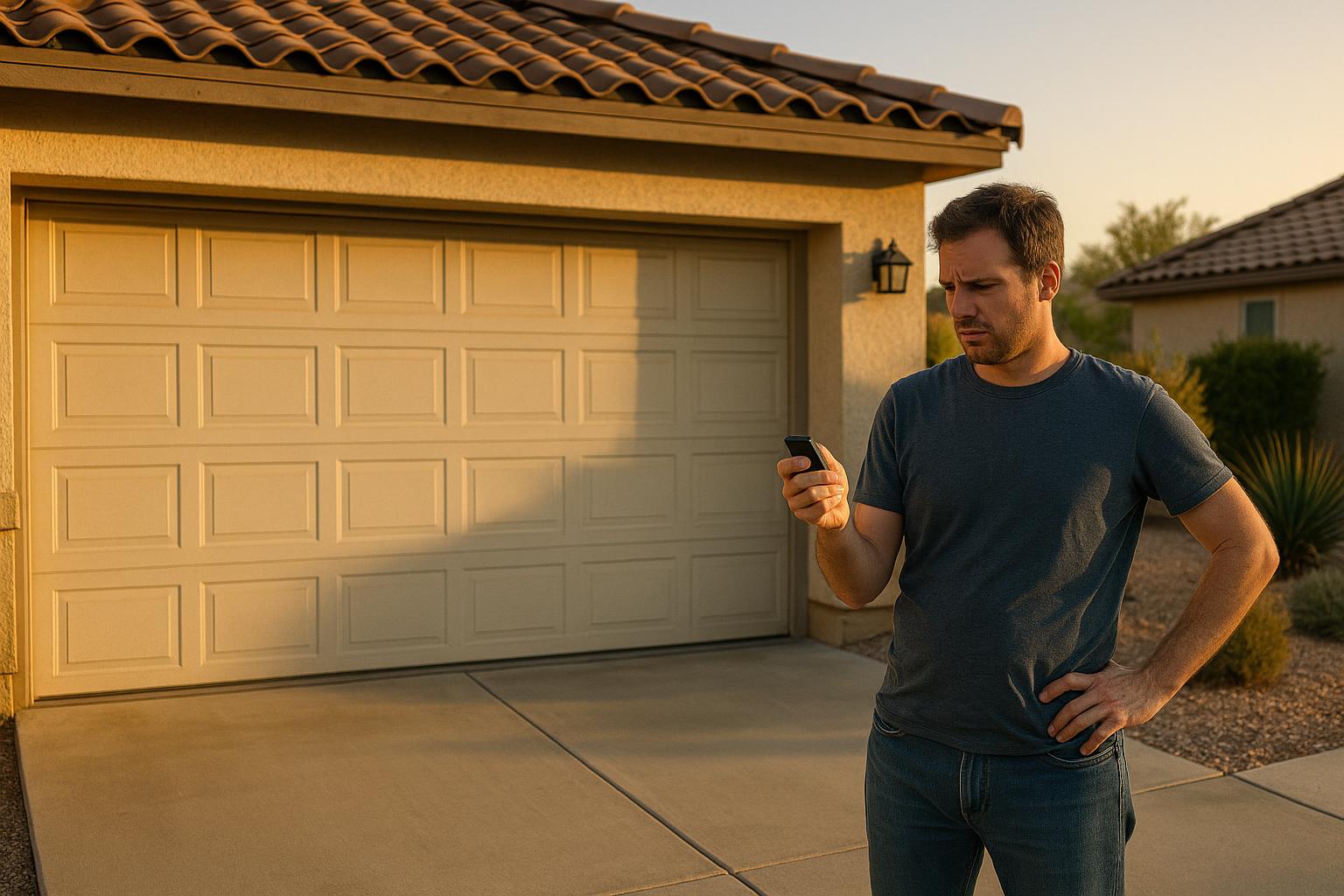
You're Running Late and Your Garage Door Won't Budge
It's 7:15 a.m. on a Monday. You've got your coffee, your keys, and exactly twelve minutes to get to work. You press the garage door opener button and… nothing. Or maybe the motor hums but the door doesn't move. Or it lifts two inches and drops back down like it changed its mind.
If you're a homeowner in Canyon Lake, you know how frustrating this scenario can be — especially when your car is trapped inside. Before you panic or start pulling on the door with all your strength, let's walk through the most common reasons your garage door won't open and what you can do about each one.
1. Dead Remote or Wall Button Batteries
It sounds almost too simple, but this is one of the most common reasons a garage door appears to stop working. The remote control in your car runs on a small battery — usually a CR2032 coin cell — and when it dies, pressing the button does absolutely nothing.
What to try:
- Replace the battery in your remote control and test it again.
- Try the wall-mounted button inside the garage. If the wall button works but the remote doesn't, the issue is definitely the remote.
- If neither the remote nor the wall button works, the problem is likely with the opener unit itself or the power supply.
2. The Opener Is Unplugged or Has No Power
Power outages overnight, tripped breakers, and accidentally unplugged cords happen more often than you'd think. Canyon Lake homeowners sometimes experience brief power surges during Santa Ana wind events or summer storms that can trip a circuit breaker without anyone noticing.
What to try:
- Check that the garage door opener is plugged into the ceiling outlet.
- Look at your electrical panel for a tripped breaker and reset it if needed.
- If you have a GFCI outlet in the garage, press the reset button on the outlet itself.
3. The Lock Mode Is Engaged
Many modern garage door openers have a lock or vacation mode feature. When activated — sometimes by accidentally holding down the wall button too long — the opener ignores all remote signals. You'll usually see a small LED light on the wall console that indicates lock mode is on.
What to try:
- Check your wall-mounted control panel for a lock indicator light.
- Press and hold the lock button for a few seconds to disengage it.
- Refer to your opener's manual if you're unsure which button activates the lock feature.
4. The Photo-Eye Sensors Are Blocked or Misaligned
Every garage door opener manufactured after 1993 is required to have photo-eye safety sensors near the bottom of the door tracks. These sensors send an invisible beam across the opening, and if something breaks that beam — or if the sensors get knocked out of alignment — the door may refuse to close or, in some cases, won't operate at all.
What to try:
- Look at the two small sensors on either side of the door near the floor. Each should have a steady light — usually one green and one amber.
- If a light is blinking, gently adjust the sensor until it's pointing directly at its partner across the opening.
- Wipe the sensor lenses with a clean cloth. Dust, cobwebs, and even morning dew can interfere with the beam.
5. A Broken Spring
This is the big one. If you hear a loud bang from the garage — sometimes described as sounding like a gunshot — and then the door won't open, there's a strong chance a torsion spring has snapped. The springs do the heavy lifting for your garage door, and without them, the opener motor simply can't raise the door on its own.
What to do:
- Do not attempt to open the door manually or repair the spring yourself. Garage door springs are under extreme tension and can cause serious injury.
- Look at the horizontal bar above the door (the torsion tube). If you see a gap in one of the tightly wound coils, the spring is broken.
- Call a professional garage door technician to replace the spring safely.
Broken springs are one of the most common service calls we handle for homeowners throughout Canyon Lake and nearby communities like Lake Elsinore and Menifee. It's a repair that should always be left to trained professionals with the right tools and experience.
6. The Disconnect Switch Was Pulled
Your garage door opener has an emergency release cord — usually a red handle hanging from the track rail. If someone pulled this cord, the door is disconnected from the opener, meaning the motor will run but the door won't move.
What to try:
- Pull the red emergency release handle toward the opener motor (not away from it) to re-engage the trolley.
- Press the opener button and let the trolley reconnect as the carriage moves along the rail.
- Once reconnected, the door should operate normally again.
7. Worn or Damaged Cables
Garage door cables work alongside the springs to lift and lower the door in a controlled manner. If a cable has frayed, snapped, or come off the drum, the door may be stuck in place, hanging crooked, or feel impossibly heavy when you try to lift it manually.
What to do:
- Visually inspect the cables on both sides of the door. Look for fraying, slack, or cables that have jumped off the drum at the top.
- Do not attempt to rewind or replace cables yourself. Like springs, cables are under significant tension.
- Contact a garage door repair company to handle the replacement safely.
8. The Tracks Are Obstructed or Damaged
Over time, garage door tracks can accumulate debris, develop dents from accidental impacts, or shift out of alignment. Even a small obstruction or bend in the track can prevent the rollers from traveling smoothly, causing the door to jam partway or refuse to move at all.
What to try:
- Inspect the vertical and horizontal tracks for visible dents, debris, or obstructions.
- Remove any objects that may have fallen into the track path.
- If the tracks are bent or misaligned, a professional adjustment is recommended to avoid further damage to the door panels or hardware.
When to Call a Professional
Some of the issues above — dead batteries, tripped breakers, sensor alignment — are quick fixes you can handle on your own. But anything involving springs, cables, or significant track damage is a job for a trained technician. Attempting these repairs without proper training and tools puts you at risk of serious injury and can cause additional damage to your garage door system.
At Canyon Lake Garage Door, we provide fast, reliable repair service to homeowners throughout Canyon Lake, Wildomar, Murrieta, Temecula, and the surrounding Inland Empire area. When your morning gets derailed by a garage door that won't cooperate, we'll get you back on track — often the same day you call.
A Few Preventive Tips to Avoid Morning Surprises
- Schedule annual maintenance. A professional tune-up catches worn springs, fraying cables, and alignment issues before they leave you stranded.
- Test your door monthly. Open and close it a few times and listen for unusual sounds or hesitation.
- Keep spare remote batteries on hand. It's a two-dollar fix that saves a lot of frustration.
- Lubricate moving parts like rollers, hinges, and the torsion spring every six months with a silicone-based garage door lubricant.
A little attention goes a long way toward making sure your garage door works reliably every single morning — no surprises, no stress, no being late to work.